An old American skillet is lighter than a new one, and smoother, and it cooks better. That isn't nostalgia. It's how the thing was cast and machined, and every bit of that history is on the bottom of the pan where you can read it.
The maker's mark. The size number and the pattern number. The heat ring, or the lack of one. The gate mark. Each narrows the date, and together they tell you what you're holding and roughly what it's worth.
And the thing that destroys value most often is the thing people reach for first: cleaning it the wrong way, with the best intentions, on a Saturday afternoon.
Inside the book
What the bottom tells you
Five things to look at, in order, every time you pick one up. The book draws each of them on real pan bottoms so you can match what's in your hand.
- The mark. Which maker, and which of their eras — the lettering changed more often than people realize, and that's what dates it.
- The numbers. Size number, pattern number, and what it means when they don't agree.
- The heat ring. Full, partial or none: a plain clue to the decade, drawn type by type.
- The gate mark. A line across the bottom puts the piece before about 1890. It's the fastest date in the book.
- How it sits. Flat, spinner or rocker, checked in ten seconds on a countertop — this is the one that decides whether it's a cook's pan or a shelf piece.
Read the casting, not the name. A great many pans were never marked at all, and some of the best cooking iron in the country is sitting in thrift shops with nothing on the bottom but a number.
The book spends as much time on placing unmarked pieces as it does on the famous makers, because that's where the finds are.
What's in it
What's in the 125 pages
- Griswold, Wagner and Lodge era by era, with the marks drawn and dated — including Lodge's unmarked years, which is where most people go wrong.
- The other makers: Birmingham Stove & Range, Favorite Piqua, Wapak, Vollrath, Martin, Sidney, Erie — and how to place a piece that says nothing at all.
- Spotting reproductions and damage before you pay: fake marks, rough texture, cracks, warps, pitting and welded repairs, with a five-minute field check made to print.
- Value in tiers that won't go stale: maker, era, rarity, size, condition and whether it sits flat — plus where to hunt and how to pack a pan so it survives the mail.
- Restoring safely: lye and electrolysis done properly with the right protection, why fire and self-cleaning ovens ruin pans, rust removal, a lead test for old pieces, and seasoning that actually holds.
- Cooking and care, the myths sorted from the rules, and five recipes to break a pan back in.
What you get
Here's exactly what lands in your account.
- The Cast Iron Collector's Field Guide — 125-page illustrated PDF, 10 chapters, 7 × 10 in
- The printable pack — the checklists and charts from the back of the book, sized to print
- Straight away — in your account the moment you pay, and emailed to you
- No copy protection — read it on any device, print it, keep it for good
Look inside
Four real pages
Click any page to enlarge it here. Nothing downloads.
The Cast Iron Collector's Field Guide
$29 · PDF · 125 pages · Instant PDF download
The contents
Everything in the book
- Introduction: Turn It Over
- Part One — Reading Iron
- Part Two — Pieces, Damage and Value
- Part Three — Restoring and Cooking
- Appendix A: Mark Index
- Appendix B: Quick Dating Chart
- Appendix C: Size Chart
- Appendix D: Heat Ring Guide
- Appendix E: Checklists (Field Check, Restoration, Lead Test and Hot Iron, Collection Log)
- Appendix F: Glossary
The details
- Format
- Illustrated PDF ebook, full color
- Length
- 125 pages, 10 chapters
- Page size
- 7 × 10 in – reads well on a tablet, computer or phone
- Printing
- Print any page for your own use. Checklists included.
- Copy protection
- None. Download it and keep it.
- Delivery
- Instant. Download straight after you pay.
The ways good iron gets ruined
- A wire wheel, because the rust looked like the problem.
- A fire, or a self-cleaning oven, because somebody online said it was quick.
- Scrubbed-off marks, taking the date and most of the value with them.
- A crack that was there all along and never got looked for.
- A pan sold for ten dollars at a yard sale because nobody turned it over.
Who it's for
This is for you if
- You've inherited cast iron and want to know what it is
- You hunt flea markets, thrift stores and estate sales
- You cook on old iron and want to buy better pieces
- You've started collecting and want the identification to be solid
It isn't for you if
- You want current market prices — you get tiers, and the reasons behind them
- You only cook on new iron and have no interest in the old: most of this book won't be for you
Who wrote it

I'm Roy Bickford. Erie, Pennsylvania.
My father's No. 8 Griswold goes on the burner most mornings — eggs, potatoes, and cornbread on Sundays, because Marlene says that's what it's for. I've never sold it and I don't intend to. The rest of the pans in this house come and go: they arrive rusted, they get stripped and brought back, and they go home to whoever sent them.
Go turn one over.
Read it for 60 days. If it's not for you, I'll refund it.
Email support@oldhands.co within 60 days of buying and you get your money back in full. No questions, no forms, and you keep the file.
Before you buy
Questions
Can I identify a pan that has no marks at all?
Often, yes. Shape, handle, heat ring, gate mark, wall thickness and the numbers all narrow it, and the book walks through unmarked pieces specifically.
Is restoring dangerous?
Lye and electrolysis both deserve respect, and the book is specific about protection, ventilation and what not to do. It's also clear about the two methods people try that wreck pans outright.
Will it make my old pan safe to cook in?
It'll show you how to test an old piece for lead before you cook in it, how to strip it properly and how to season it so it holds. Some pieces belong on a shelf, and the book says which.
How do I get it after I pay?
Checkout is handled by Whop, a payments company. The moment you pay, the PDF is in your Whop account to download, and the link is emailed to you as well. You can download it again any time.
Is this a printed book?
No. It's an ebook: a PDF you download straight after paying. You can print any page, or the whole thing, for your own use.
Will it open on my phone?
Yes. It's an ordinary PDF, so it opens on any phone, tablet or computer. A tablet or computer shows the pages best.
What if I don't like it?
Email support@oldhands.co within 60 days and you get a full refund. You don't need to give a reason.
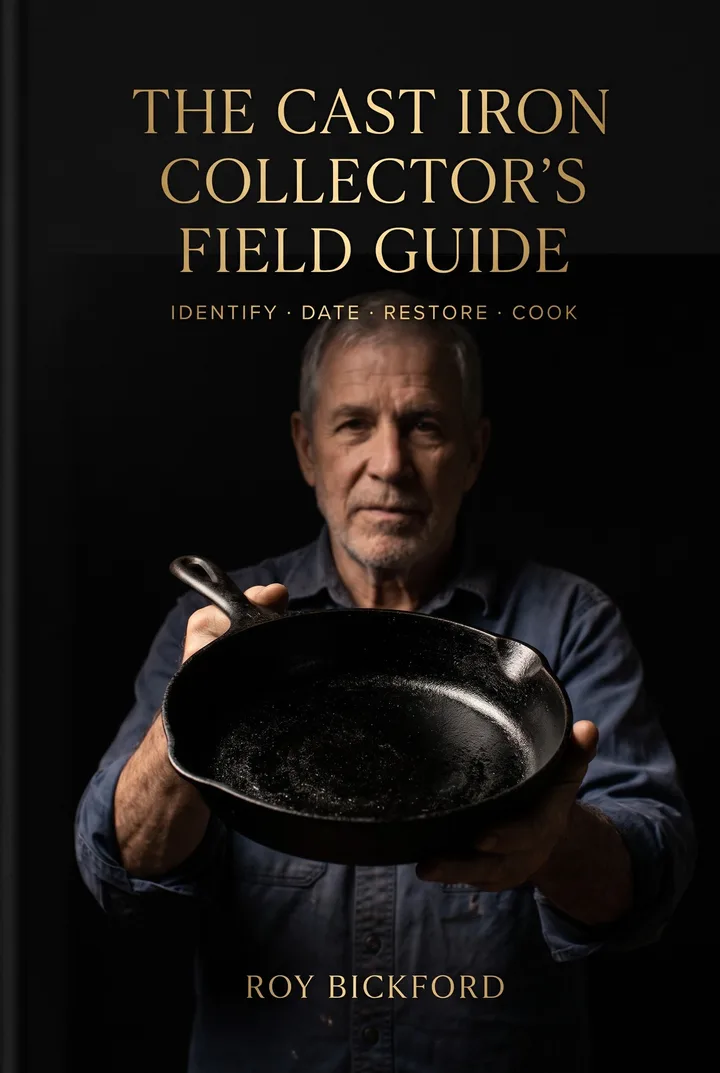
The book
About what one good flea-market find costs.
$29 once, with the mark index, the size chart, the heat ring guide and the restoration checklist in the back.
- 125-page illustrated PDF, 10 chapters, 7 × 10 in
- the checklists and charts from the back of the book, sized to print
- in your account the moment you pay, and emailed to you
- read it on any device, print it, keep it for good
Instant PDF download · 60-day money-back guarantee
Iron doesn't lie. Go turn one over.